Probiotics and prebiotics for dogs are a nutritional power group.
Separately, they perform quite different functions, but together they ensure a well-balanced, peaceful environment in the gut by promoting growth of the beneficial bacteria your dog needs to help digest food, absorb nutrients, prevent disease and maintain a healthy immune system. (1)
There is so much scientific jargon bouncing around in the world of dog digestive health which can make it difficult to really understand the importance of their gut health, how exactly you utilise things like pre and probiotics to better their overall health.
Both Probiotics and prebiotics for dogs are integral to promoting harmony in your pooch’s gut, so read on to learn about the important relationship between them both and how to incorporate their powerful gut-protecting attributes into your dog’s diet.
What are probiotics for dogs?
Probiotics contain live bacteria that have a known benefit on the host (in this case, dogs!)
Dogs have plenty of beneficial bacteria already present in their body, but can often benefit from more.
When fed to a dog, probiotics can come as a supplement, as high-quality wet or dry dog food, or as natural whole food. Kefir is a prime example of a natural probiotic source, as well as vegetables packed with fibre that act as prebiotics to feed the probiotic bacteria.
What are prebiotics for dogs?
Prebiotics are carbohydrate compounds that, unlike probiotics, aren’t digestible by your dog’s body - but actually act as food sources for the beneficial bacteria already present.
By supporting the growth of beneficial bacteria, prebiotics help suppress the harmful microbes that make your dog ill, boosting their immunity and overall digestive health.
Again, prebiotics for dogs can either be fed in supplement form, as wet or dry dog food, or via prebiotic-rich natural foods such as chicory root, or dandelion greens.
How do pre and probiotics for dogs work?
When your dog has finished a nutrient-rich meal, that’s when prebiotics and probiotics get to work to strengthen your dog’s tum…
-
Probiotics are digested, broken down and released as healthy bacteria into your dog’s gut and intestinal tract. If you think of the word ‘probiotics’, that’s exactly what these bacteria are doing - adding to the climate of beneficial bacteria in your dog’s digestive microbiome.
-
Prebiotics, indigestible to the body, travel unscathed through the dog’s stomach and intestines until they reach the colon. Here, the microbiome converts them into short-chain fatty acids (SCFA). SCFA (such as butyrate, propionate and acetate) allow direct communication between the bacteria in the dog's gut and the cells that make up the gut wall.
Probiotics and prebiotics are a power combo for your pooch’s gut health, which is why they’re often found together in digestive supplements for dogs. Combining the power of pre- and probiotics, alongside some yeasts, creates a synbiotic - an all-in-one that mimics the entire gut ecosystem.
Why not just give all dogs synbiotics?
Well, for many dogs, taking a phased approach (like with the supplement plan) allows for more gradual changes over time and long-term benefits.
Synbiotics work great for either targeting specific issues (e.g. Gut-Joint axis, which is complex and needs to be targeted from multiple angles) or a quick solution to support antibiotic recovery (e.g. our Microbiome Support Supplement)
![]()

Postbiotics are products made from bacteria or yeast that can still benefit your dog’s health.
With probiotics, it is the activity of the live bacteria—the way they function and interact within the gut ecosystem—that directly supports digestion, immunity, and overall well-being. In contrast, postbiotics work through what the bacteria or yeast contain.
When bacteria die and begin to break down, their cell walls release compounds that can support the body in various ways, even without active bacteria.
Yeasts also play a role in the dog’s gut microbiome, though they are less abundant than bacteria.
While we still have more to learn about their exact functions, yeast cell walls are packed with beneficial components, whether the cells are alive or not, that can help maintain a healthy, balanced gut.
One of the biggest advantages of postbiotics is their stability. Because they do not contain live bacteria, they are far less sensitive to heat, light, and storage conditions than probiotics, making them easier to formulate and deliver consistently.
Postbiotics can also help enrich and stimulate other microorganisms in the gut ecosystem, supporting a more resilient and diverse microbiome overall.

When should you use probiotics and prebiotics?
There are plenty of scenarios for which it’s helpful to give your dog’s gut health a boost in balancing its natural flora.
-
If your dog is recovering from a bout of gastroenteritis, it's likely their gut flora could do with a surge of beneficial bacteria, as the microbiome of their stomach is often stripped of goodness when your dog has been vomiting or suffering from diarrhoea.
-
Even simple toilet issues, such as diarrhoea or constipation, may be an indicator that your dog could benefit from more probiotics and prebiotics in their diet (2). An excellent sign of a healthy gut is your dog pooping less frequently and having smaller poops. This suggests the bacteria are working to extract more nutrients from the food, leaving less waste for you to pick up at the end!
-
If probiotics add to the healthy bacteria in the gut, antibiotics do the opposite; killing off all bacteria, including the good stuff, in order to beat an infection. When your dog has been on a course of antibiotics, try supplementing their diet with pre and probiotics to ensure their gut flora is re-balanced and they can quickly get back on tail-wagging form.
Top tip: If you give them their antibiotics in the morning, give a probiotic in the evening. Also, provide probiotics as soon as the antibiotic course has stopped.
-
Believe it or not, a host of non-digestive issues can also be traced back to an imbalance in the gut. Itchy skin, allergies, a yeast infection or stress in dogs can all be improved by probiotics and prebiotics. (4)
To really find out what's going on inside your dog's gut, try a Pooch & Mutt Gut Health Test!
From sending off a simple sample of your dog's poop, we analyse it in our labs to see what bacteria are living in their microbiome and whether they have the right balance for optimum health and wellbeing. From their results, we can recommend a completely tailored supplement plan that's backed by science. With consistency, they're gut can get back on track!
-
An increase in dog farts (flatulence) could also be a sign of disharmony in the gut that may require attention.
30% of dogs have sulphur-producing bacteria, and 20% have methane-producing bacteria - key culprits for canine malodour!
How long does it take for pre and probiotics to work in dogs?
It depends on the dog, but improvements to tummy or toilet issues should start to show within a few days of introducing probiotics and prebiotics, and can even cut recovery time in half. If your dog’s digestive condition is slightly more severe, pre and probiotics could take around 4-6 weeks to take effect. If you’re using them as part of a preventative plan, it’s fine to feed your dog pre and probiotics every day.
Note that not every dog needs a boost of probiotics and prebiotics, as they may be getting enough already through diet. Pre and probiotics for dogs are highly unlikely to cause any harm, but this is why our Dr Bushra and our microbiology team are conducting extensive research on their effect on different dog breeds, ages and health conditions.
To find out what's really going on inside your dog, a Gut Health Test is the next step.
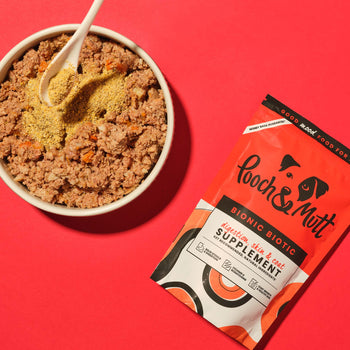
If you’d like to learn more about digestive health in dogs, get in touch with us. To use the power duo of prebiotics and probiotics to get your dog’s gut into tip-top shape, check out Pooch & Mutt’s Bionic Biotic pre and probiotic supplement.
References
- JMB‘Microbiota and probiotics in canine and feline welfare’, 2015 - National Library of Medicine.
- ‘Efficacy of a Probiotic-Prebiotic Supplement on Incidence of Diarrhea in a Dog Shelter: A Randomized, Double-Blind, Placebo-Controlled Trial’, 2017 - National Library of Medicine.
- ‘The Utilisation of Prebiotics and Synbiotics in Dogs’, Italian Journal of Animal Science, 2014 - Taylor Francis Online.
- 'A Double-Blind, Placebo Controlled-Trial of a Probiotic Strain
Lactobacillus sakei Probio-65 for the Prevention of Canine Atopic
Dermatitis, 2015 - JMB








Comments (3)
My Jack Russell has IBD we found out after a mid night hemorrhage and almost lost him. He takes 1 steroid every third day and an antibiotic every day which has kept him stable. Your wet chicken food has been a god send but do you think a pro or prebiotic supplement would be than steroids. If we mix a steroid his tummy makes an awful noise and he’s in obvious discomfort. Linda
I’m wondering if the Bionic Biotic is a combination of pre and probiotics. Its not clear in your advert.
Hi Sandi,
Our Bionic Biotic contains both Pre & Probiotics, we will get feedback passed onto our team to make this clearer on the product page. :)
Leave a comment